
The Hero I Was Allowed to Have: How Roy Rogers Shaped My Childhood
I grew up in a world where heroes were carefully curated for us. They had to be safe, wholesome, morally upright and most importantly, approved. In a high‑control, fundamentalist environment, even your imagination had boundaries. You couldn’t just admire anyone; you had to admire the “right” people.
For me, one of those “right” people was Roy Rogers, the King of the Cowboys.
Married couple Roy Rogers and Dale Evans rode through America’s heart in a post‑war era where patriarchy, beating the bad guy and the wild American spirit were central themes. In our home, they weren’t just entertainers, they were symbols. They represented a version of goodness that fit neatly inside the rules: clean, cheerful, patriotic, family‑friendly and God‑honoring. Their movies and TV shows were some of the few things we were allowed to watch without scrutiny. In a world where most of culture was considered dangerous or corrupting, Roy and Dale were the exception.
Which meant they became some of the only heroes I was allowed to have.
The Goodness They Gave Us
To be honest, Roy and Dale offered something genuinely beautiful. Their lives were marked by generosity, faith and a steady, unshowy kindness. They adopted children, advocated for kids with disabilities and lived out a version of Christianity that felt more like compassion than control. Looking back, it makes sense that I eventually gravitated toward the gentler, more expansive side of faith - the one that looks more like them than the system I was raised in.
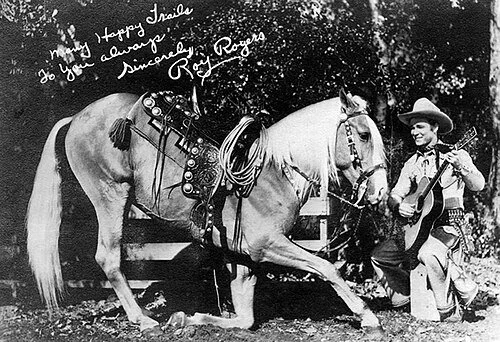
PC@Wikipedia
Their shows were full of simple moral lessons: courage, honesty, loyalty, doing the right thing even when it was hard. As a child, those messages landed softly. They were a reprieve from the harsher, fear‑based teachings of my religious environment.
There was something grounding about Roy’s crooning and yodeling, Dale’s full‑face smile, the way the bad guys always got caught and the good guys always rode home at sunset. It was predictable in the best way. Safe. Gentle. A world where problems could be solved with integrity and a good horse.
And here’s the truth: I still love and respect Roy and Dale.
Their kindness was real. Their goodness mattered. They were bright spots in a childhood that didn’t offer many.
But loving them doesn’t mean ignoring the way their image was used in my life.
The Cultural Imprint on My Childhood
Roy Rogers wasn’t just entertainment; he was a cultural anchor. His world shaped the aesthetics of my childhood:
the cowboy hats and boots
the idea that goodness looked like politeness and a firm handshake
the belief that faith and patriotism were inseparable
the sense that “real America” lived somewhere between a ranch and a revival tent
His movies and shows were woven into the fabric of my life: weekends, sick days, long afternoons when school was over or it was too hot to go outside in the Texas heat. Roy and Dale were always there, smiling from the screen, offering a version of the world that felt warm and familiar because it echoed what I was already being taught about gender, faith, America and my “place” in all of it.
So when I talk about Roy Rogers shaping my childhood, I don’t just mean I liked his movies. I mean his carefully curated world (which I submit was rooted in the era it was created) sat at the intersection of my religion, my politics, my family values and my imagination, and for a long time, I didn’t know there were other worlds available.
There was another layer too, one I didn’t understand until much later.
The Patriarchal Pat on the Back
In the world I grew up in, Roy Rogers wasn’t just a wholesome cowboy hero. He was held up as the gold standard of what a “real man” should be: strong, steady, problem-solving, protective, decisive, always in charge. And Dale Evans, for all her talent and grit, was framed as the ideal woman beside him: supportive, cheerful, loyal, always ready to save her man.
The fundamentalist culture I was raised in loved that dynamic. It reinforced the message that men lead and women follow. Men protect and women submit. Men act and women support. Even when Dale was clearly the brains or the heart of the story, the narrative always circled back to Roy as the hero - even though her character was often far more witty, capable and independent than most women were ever allowed to be on screen at the time.
And that mattered, because in high‑control systems, media isn’t just entertainment, it’s instruction.
Roy and Dale became templates:
He was the chosen leader.
She was the faithful helper.
He made decisions.
She made everything run smoothly behind the scenes.
He saved the day.
She smiled, sang and kept the home fires burning.
It wasn’t malicious. It was cultural. But it was also limiting.
As a little girl, I absorbed the message that my highest calling was to be someone’s Dale Evans - pleasant, supportive, spiritually strong but never threatening, never overshadowing. Roy was the hero. Dale was the heart. And I was expected to grow into the heart, not the hero.
That’s the patriarchal pat on the back baked into the nostalgia: look how good it is when everyone stays in their place. And in my world, “your place” was non‑negotiable.
The Heroes We Were Allowed to Have
In a high‑control religious environment, heroes aren’t just admired, they’re assigned. Or at least, you know the short list you “get” to choose from.
You’re taught who is safe to look up to, who is acceptable, who won’t lead you astray. And the list is always carefully curated.
Roy Rogers made the cut because he fit the mold:
clean language
traditional values
Christian faith
family‑centered life
no moral ambiguity
no messy humanity
He was the kind of hero who wouldn’t challenge the system. He reinforced it.
So, while other kids were discovering superheroes, musicians, athletes or complex characters with flaws and depth, my world narrowed to a handful of “approved” figures - mostly missionaries. Roy Rogers wasn’t just a childhood favorite; he was one of the only options.
When your heroes are chosen for you, you learn early that admiration is not an act of freedom. It’s an act of compliance.
The Complicated Gift
I hold Roy and Dale with genuine affection. They were bright spots in a childhood shaped by rigidity and fear. They offered gentleness where other parts of my world offered judgment. They modeled kindness in a culture that often confused control with holiness.
But I also recognize the constraint.
I wasn’t allowed to explore the wide, wild landscape of human creativity. I wasn’t allowed to find heroes who were messy, complex or different. I wasn’t allowed to discover who I admired. I was told who I should or could admire.
Roy Rogers shaped my childhood in ways that were both comforting and confining.
He was a good man. Dale was a remarkable woman. And I still respect them both. (I might even still own a few dozen of their films, along with many books and vintage collector pieces.) Their version of Christianity didn’t always fit their era’s mold, and it certainly didn’t perfectly match what I had been taught. For that, I am grateful.
Looking Back With Both Hands Open
Now, as an adult, I can hold both truths:
Roy and Dale offered something genuinely good.
And I deserved a childhood where I could choose my own heroes.
I can appreciate the warmth of those old black‑and‑white episodes while also grieving the narrowness of the world that surrounded them.
Roy Rogers was the hero I was allowed to have, but he wasn’t the only hero I needed. He did meet a real need, though, the deep, childlike knowing that I needed to be rescued from something.
It was my daughter who first put words to this. “Mom, maybe you liked Roy Rogers so much because it was part of your childhood trauma. He was the only person you were allowed to like.” She was right.
Possibly that’s the real story here: the journey from assigned heroes to chosen ones, from curated imagination to authentic curiosity, from a world of limits to a life where I finally get to be the hero in my own story.
I may have absorbed a bit more of Dale’s feistiness than I knew.
Happy Trails
This article is not intended to treat or diagnose any condition.
Rebekah is not a licensed therapist or clinician. Any thoughts, opinions or resources given on this site are strictly her own observation and insights based on personal experiences and study. It should in no way take the place of professional assistance.