
The Danger Wasn’t Hollywood - It Was the Pulpit
Sometimes it’s hard to explain what life inside evangelical fundamentalism was like to people who never lived it. The rules, the separatism, the superiority, the fear of the “world” — all of it felt normal when you were inside. And after more than a decade without connection to that space, I’ve noticed some of the details fading. And it’s been early twenty years of questioning, deconstructing, and embracing who I am today.
Not long ago, while sick in bed with the flu, I was scrolling for something mindless to watch and landed on reruns of a newer show. It wasn’t great, but one storyline caught my attention. A trad‑wife influencer, her book launch, and the crowd of women and couples following her every word. Yes, the trad‑wife phenomenon made it into mainstream TV.
They didn’t get everything right, but they got close enough to send me spiraling back to my early years as a young evangelical wife and mother. And suddenly, one of the old rules I’d been handed resurfaced.
I didn’t see an R‑rated movie until I was married. Nothing PG‑13 until I was over eighteen. I remember encouraging my new husband to throw away a couple of his movies because of how “bad” they were. I’d been taught that hearing curse words, seeing violence, or watching a sex scene - even kissing - would desensitize us to evil and open the door for Satan to infiltrate our home. Television was a gateway drug. Many families I knew didn’t own a TV at all. We only watched VHS tapes. No cable. No paid TV.
As a kid at Blockbuster, I had to keep my eyes on the floor until we reached the Family and Kids section. The only movie I ever saw in a theater was Bambi, because movie theaters were dens of sin. HBO was “Hell’s Box Office.” My mother even framed the verse, “I will set no evil thing before mine eye,” and hung it next to the TV as a warning.
So there I was, watching a cheesy show that never would have met the standards I grew up with, when the trad‑wife storyline collided with my own memories…and something clicked.
I applied the same logic I’d been raised with, just flipped it in a new way with this realization:
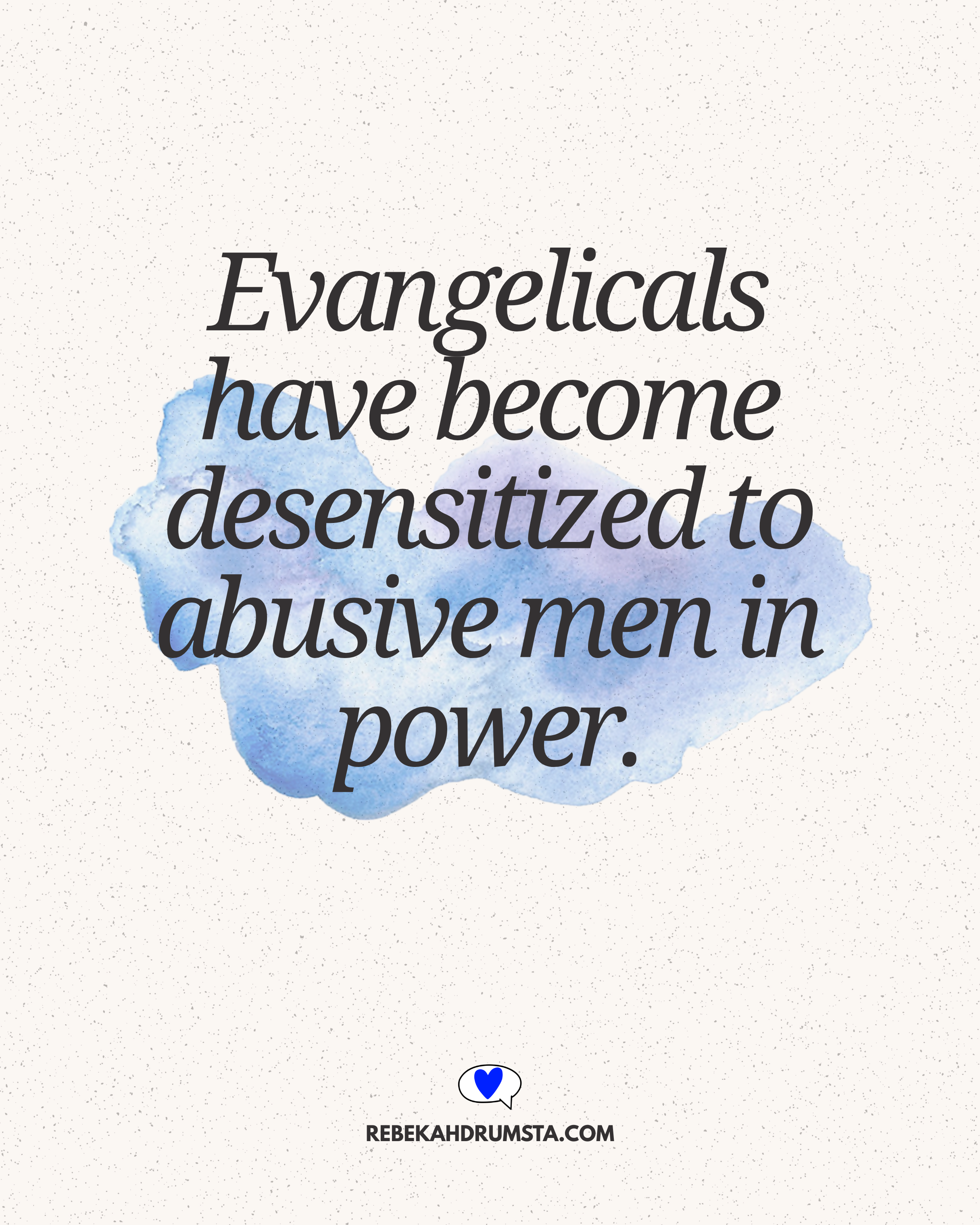
Evangelicals have become desensitized to abusive men in power.
How many men preached sermons while I sat in the pews who had been accused of abuse, immorality or caught in illegal behavior? More than I can count. Guest speakers with known histories. Leaders with documented harm. And we’ve all seen the headlines: abuse of power, sexual misconduct, financial exploitation. It’s not an anomaly - it’s a pattern.
The system that protects, minimizes, and covers up abuse by church leaders wasn’t built overnight. It was crafted over centuries. And instead of safeguarding innocence, truth, or integrity it has evolved into a structure that fortifies power at the expense of people.
Regular exposure has numbed the American evangelical church to abusive men in authority.
For survivors of systemic abuse, it’s no surprise to watch communities circle the wagons around powerful figures who claim Christian identity while leaving a trail of harm behind them. When your normal was “don’t question the man of God,” or “obedience at all costs,” speaking truth to power feels dangerous, even when it’s necessary.
This is how harmful leaders gain influence, credibility, and ground. Not because they’re righteous, set apart, ordained by God…but because the system has conditioned people to defend them.
And when we demonize those we disagree with - the “sinners,” the outsiders, the people on the other side of a vote - it becomes easy to believe they deserve whatever happens to them. Meanwhile, the harm inside our own walls goes unchallenged.
Maybe it’s time to ask harder questions:
Have I been desensitized to leaders getting away with abusive behavior?
Is it time for me to speak truth to power?
What systems am I upholding that allow leaders to live by rules that don’t apply to anyone else?
When people disclosed harm or concerns about a leader, how were they treated - and why was that acceptable?
These questions aren’t about blame. They’re about the courage to see what’s been in front of us all along.
To note: While this piece focuses on men in evangelical leadership, abuse and the misuse of power are not exclusive to men. Women can and do perpetuate harm within these systems. The difference is structural: in most evangelical spaces, far fewer women hold positions with enough authority to cause widespread damage. But the same dynamics of control, secrecy, double standards and unquestioned spiritual authority apply regardless of gender. The system itself makes abuse possible and that system does not discriminate.
This article is not intended to treat or diagnose any condition.
Rebekah is not a licensed therapist or clinician. Any thoughts, opinions or resources given on this site are strictly her own observation and insights based on personal experiences and study. It should in no way take the place of professional assistance.